
How to Open a Garage Door Without Power, Safely
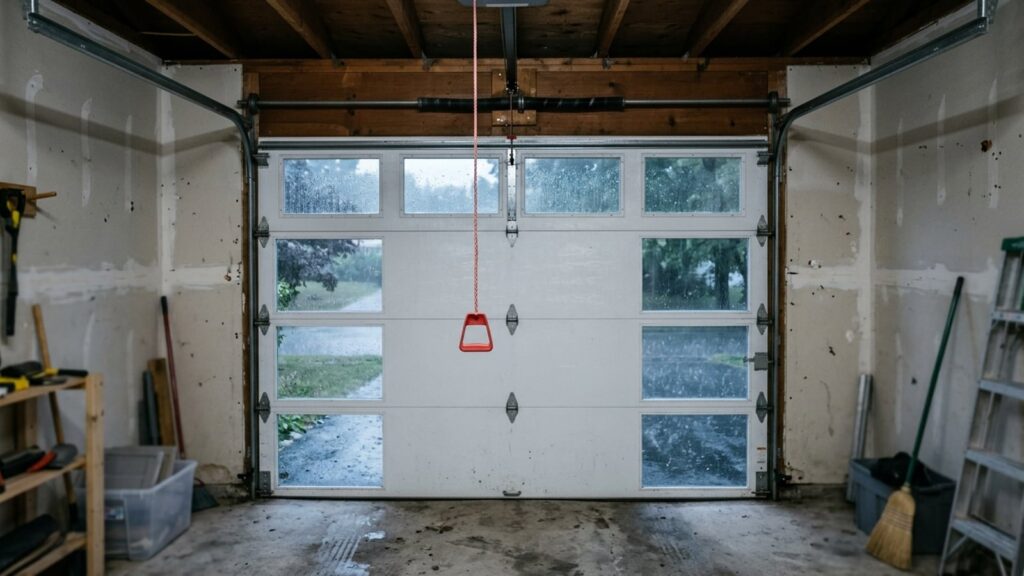
To open a garage door without power, start with the door closed, check that the springs and cables look intact, then pull the red emergency release cord and lift the door by its handles. If the door feels too heavy to lift safely or will not stay up, lower it gently and leave it closed. A door that heavy may have a broken spring, and lifting it by hand is not safe.
Eastern Iowa’s June thunderstorms make it worth knowing how to open a garage door without power before you need to. Here is how to check the door, release it, secure it while the power is out and reconnect the opener when the lights come back on.
Check the door before you pull the cord
Genie, one of the opener makers we work with, starts its power outage instructions with a look at the hardware: make sure the springs are intact and nothing in the door system is damaged. From inside the garage, look for a broken spring, a cable hanging loose or a section that looks bent.
If anything looks broken, leave the door connected and closed. DASMA, the Door and Access Systems Manufacturers Association, tells homeowners not to attempt to remove, adjust or repair doors or springs, because doors are heavy objects moved by springs under extreme tension, and to contact a trained door systems technician instead. Genie also says that if the door is too heavy to lift by hand, you should avoid opening it manually and contact a professional.
How to open a garage door without power
Once the door is fully closed, pull the red release handle down to disconnect the door from the opener’s carriage. Do this only with the door down. Genie’s reasoning is simple: a closed door puts the least strain on the system and has nowhere to fall.
Then lift slowly, using the inside handles. DASMA’s guide for checking a door after events like high winds says to stop if the door starts to move on its own once the opener is disconnected, and to stop if it is too heavy or hard to move. As it rises, the rollers should stay in their tracks, and the door should stay up once it is fully open.
Grip the door by its handles, never by the seams. DASMA’s data sheet on manual operation warns that the joint between two sections is not a suitable gripping point and that grabbing it could cause serious injury.
If the door was open when the power went out
Think twice before pulling the cord on a door that is already up. This is where Genie’s advice to release only a closed door matters most. Once an open door is disconnected, only its springs hold it up, and DASMA’s guide says to stop at once if a disconnected door starts to move on its own.
The safest choice is usually to leave an open door where it is until the power comes back, and to keep the inside door from the garage to the house locked in the meantime. If the door has to come down sooner and you have any doubt about the springs, call for help rather than releasing it.
Closing and securing the door while the power is out
Once you open a garage door without power, lower it the same way, slowly and by the handles. Before you drive off, Genie suggests making sure you have another way back into the house, because the release cord cannot be reached from outside a garage with no other door.
Genie’s answer to that is an emergency release kit, a keyed lock in the garage door that releases the opener from outside. Without one, plan to come and go through the house until the power returns.
A disconnected door is not held shut by the opener, so think about security while you are away. If your door has a manual slide lock, Amarr, a door manufacturer, notes that the opener must never be run while the slide bolts are engaged, because it will damage the door, and recommends unplugging the opener when you lock the door by hand.
Reconnecting the opener when the power comes back
Wait until the power is restored before you reconnect, as DASMA advises, and close the door by hand first. Genie describes a few ways to re-engage, depending on the model, from pulling the cord until you hear a click to pushing the release lever up with a broom handle, so check your owner’s manual.
If you slid a manual lock into place, open it before you press the button. Then test the reversing feature, which DASMA lists as the last step after a door is reconnected to its opener.
If the opener will not run once the power is back, Genie suggests unplugging it for up to 30 seconds and plugging it back in to reset it. If it still will not work, a major power surge may have damaged the motor unit, and that calls for a repair.
Storm safety in and around the garage
Never run a portable generator in the garage, even with the big door open. The CPSC’s portable generator safety alert says never to use one inside homes, garages, crawlspaces or sheds, even with fans running or doors and windows open, because deadly carbon monoxide can build up quickly and linger for hours. Set it up outdoors, far from doors, windows and vents, and keep battery-operated carbon monoxide alarms, or plug-in alarms with a battery backup, in the house as the CPSC recommends.
Tornado warnings call for a different move. DASMA points out that a garage, attached or detached, is not a tornado shelter, so head for the basement or an interior room instead of waiting it out in the garage.
When the outage leaves damage behind
Call for help if the door was too heavy to lift, came out of its tracks or the opener stopped working after the storm. Our technicians repair openers, logic boards and springs on all major brands, including systems we did not install, and our emergency support is there for doors that cannot wait for a regular appointment.
A door left stuck by a storm, or an opener that stays dead once the lights are back, deserves a professional look. Anywhere in Cedar Rapids, Iowa City or Tiffin, you can request a repair visit from our team.