
Is an Insulated Garage Door Worth It in Eastern Iowa?
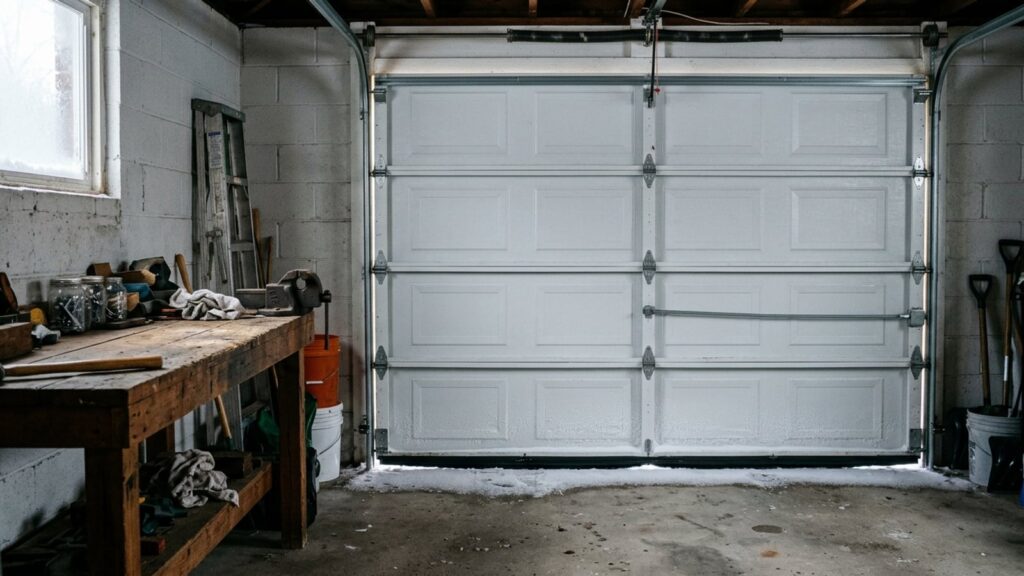
For most eastern Iowa homes, an insulated garage door is worth it, and it matters most when the garage is attached to the house, shares a wall with a bedroom or doubles as a workshop. Once you decide to insulate, the harder question is which door to buy. That comes down to the foam inside it, how its thermal performance is measured and how well it fits the opening.
Late January is when an uninsulated door makes itself known, from a chilly room beside the garage to a workbench nobody wants to use. Here is how to decide whether insulation makes sense for your garage, and how to read the ratings when you compare doors.
When an insulated garage door pays off
C.H.I., one of the manufacturers whose doors we install, suggests five questions: is the garage attached, do temperatures where you live vary drastically or stay extreme, do you use the space as a workshop or for hobbies, do you keep pets there, and might you sell the home within the next 10 years? If you answer yes to two or more, C.H.I. says an insulated garage door is the best option. Eastern Iowa answers the climate question for you, so an attached garage alone usually tips the balance.
C.H.I. calls insulation particularly important for attached garages, since the garage shares at least one wall with the rest of the house. Amarr, another of the brands we work with, points out that the garage door is pretty much the entire front side of most garages, so insulating only the walls leaves one of the four sides bare. If you heat the garage, Amarr adds, a lot of that warmth will escape without an insulated door.
How you use the door counts as well. According to C.H.I., regularly leaving it open for extended periods breaks the home’s thermal envelope, which makes the insulation much less effective.
Polystyrene, polyurethane and how the foam is fitted
DASMA, North America’s leading trade association of garage door manufacturers, explains that many manufacturers use foam plastic in sectional doors because of its insulation value, and in some cases because it adds strength to a door section. The common types it names are expanded polystyrene, polyurethane and polyurethane/isocyanurate.
According to DASMA, the foam goes in one of three ways. It can be attached in sheets or blocks as a non-structural layer, bonded to the door’s facings to form an insulated, structural sandwich panel, or foamed in place between the facings, where it also acts as the adhesive.
C.H.I. describes polyurethane as denser than polystyrene and often used as a foam that expands to seal gaps, and says it adds durability by making the door more resistant to vibration and shaking. It calls both materials versatile and moisture-resistant. The foam type alone does not tell you how a finished door performs, though, and that is where the ratings come in.
What R-value tells you, and what it leaves out
ENERGY STAR defines R-value as a measure of insulation’s ability to resist heat traveling through it, and says the higher the R-value, the better the thermal performance of the insulation. DASMA notes that in the past, the garage door industry used calculated R-value as its default thermal rating.
The catch is how a garage door’s R-value is produced. DASMA explains that it is a calculation of the thermal resistance through the center of a door section, not a measurement of a complete installed door, and that it does not account for section joints, stile attachments and similar details. Some of those elements can provide what DASMA calls a thermal shortcut around the insulation.
Why U-factor is the better way to compare doors
U-factor is measured on a complete door installed at an independent laboratory and tested to the ANSI/DASMA 105 standard, so it takes in the sections, the joints between them, the hardware and the perimeter. Lower is better. DASMA notes that a door with a U-factor of 0.20 is twice as thermally efficient as one with a U-factor of 0.40.
Because the two numbers come from entirely different methods, DASMA says they are not comparable and are not reciprocals of each other. You cannot convert a door’s R-value into a U-factor, or weigh one door’s R-value against another door’s U-factor. DASMA also points out that recognized building codes and standards deal with garage door thermal performance in terms of U-factor.
To make tested figures easier to trust, DASMA runs a Thermal Performance Verification Program for sectional doors, administered by ICC-ES, an internationally recognized testing, inspection and certification company that reviews participants’ test reports. Look for the program’s badge, label or icon. C.H.I., Amarr and Midland, all brands we work with, are listed participants.
Seals, joints and a tight fit
The foam is only one part of the door. DASMA lists section joints, stiles, thermal breaks, air spaces and weather seals among the features that can greatly affect a door’s thermal performance. It defines a thermally efficient door as one with an insulated core and a meeting rail design with a thermal break, which uses a material other than metal to minimize heat transfer from one side of the door to the other.
Fit matters as well. Every project we take on begins with accurate measurements of the opening, because the aim is a tight seal against wind, rain and snow once the new door is closed.
Insulation and a quieter garage
Insulation can help with noise, too. C.H.I. says an insulated door on a garage that shares a wall with a bedroom will be significantly quieter to operate, and it uses the sound transmission class (STC) rating to describe how well a door muffles sound. The higher the STC rating, the more effectively the door blocks sound.
If someone sleeps on the other side of the garage wall, or you run power tools out there, ask whether the doors on your shortlist have an STC rating. It is a separate figure from the thermal ratings, so check both.
How we help you choose an insulated garage door
For winters like ours in Cedar Rapids and Iowa City, we strongly recommend a high-performance insulated door. During your free estimate we help you pick the style, color and insulation level, and you can look through the brands we carry on our garage door products page before we visit.
When you are ready to compare insulated garage doors for your own home, our garage door installation team can measure the opening and talk you through the options that suit it.