
How to Choose a Garage Door Color That Handles Summer Sun
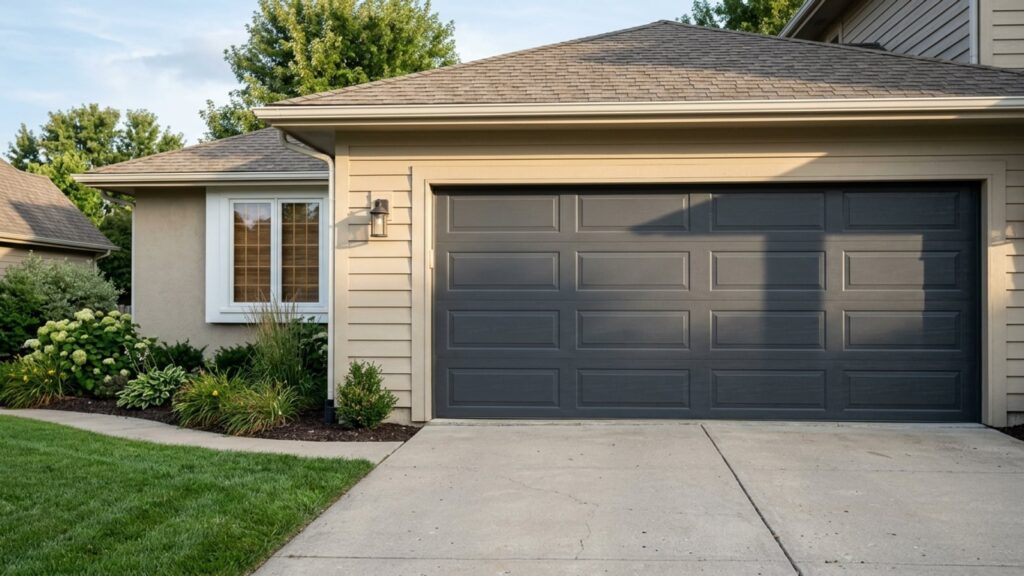
The best garage door color either matches your siding or trim or contrasts with it on purpose, in a shade that suits how much sun the door gets. On a south-facing garage, light, neutral and earthy tones last longer than bright colors. Dark colors look sharp, but on a sunny wall they bring a few extra questions to ask before you order.
Late July is a good time to step outside in the afternoon and see how much sun your own garage door gets. Here is how to weigh looks against an Iowa summer.
Match the house or make the door an accent
C.H.I., one of the door manufacturers we work with, describes two ways to match a garage door to your house. You can match the siding, which is easier when the siding is a single color and harder with brick because of its color variation, or you can match the trims, such as window frames, fascias and soffits. The alternative is to introduce an accent color and make the door a feature.
If you go with an accent, C.H.I. reminds you of the 60-30-10 rule, the percentage share of your primary, secondary and accent colors that keeps an exterior visually balanced. Its buyers guide recommends a door that contrasts with the primary color of your home, unless you want a monochromatic effect.
Keep warm and cool tones apart
The same guide advises against blending warm and cool tones, and recommends matching the garage door to your front door so the two work in harmony. A cool gray trim, for example, points toward a cool shade on the door rather than a warm tan.
Hardware counts too, and the guide suggests matching it with your front door as well. Once you have chosen, keep a note of the color name, because C.H.I. lists the matching Sherwin-Williams paint color for each of its standard door colors.
How sun exposure changes the garage door color you choose
Which way the door faces matters as much as the house. C.H.I. says that if your garage faces south, light, neutral, earthy tones will last longer than bright colors, which are more susceptible to fading in the sun. It also lists increased heat absorption as a drawback of matching the door to a dark house color.
That does not rule out a dark door, but it changes what you should ask about. In its guide to thermal bowing, the door industry’s trade group DASMA explains that an insulated door with bonded core sections bows toward the warmer side when one skin is much warmer than the other. It names a darker color among the influences: a brown insulated door facing the sun on a hot day, with an air-conditioned garage behind it, will bow more than an equivalent white door.
Orientation plays a part as well. According to DASMA, a door that faces south into direct sunlight is at greater risk of bowing than a north-facing door that stays out of it. Thermal bowing cannot be eliminated in those conditions, but door reinforcement, such as horizontal struts across the back of the door, can minimize it to where it has no appreciable effect on performance. For a large, dark door on a sunny wall, ask the manufacturer what it recommends.
Color ideas for brick and white houses
Brick needs more thought because a wall is rarely one color. C.H.I.’s guide to garage door colors for red brick suggests either complementing the dominant brick color or matching the door to an accent brick color. With intense red brick, a white garage door is a neutral hue that creates contrast, while muted reds suit green, and browns such as chocolate, tan or faux wood work well too.
Yellow, buff and cream brick pairs easily with both light and dark garage door colors, C.H.I. says, as long as you avoid anything too close to yellow. Brown brick can be brightened with a sandstone door or pushed toward an industrial look with black. Look for a color the door can pick up from the shutters, window frames, front door, fascias and soffits, or even the driveway paving.
White houses are the easiest canvas. C.H.I. notes that black doors are common on white houses for high contrast, white doors blend into the exterior and gray doors offer something more neutral, while on houses with warm, neutral tones, tan, wood-effect or sandstone doors are popular.
Dark finishes on wood doors and overlays
Wood reacts differently. DASMA’s wood finishing guidelines caution that a dark color on a door in direct sun may cause high temperatures on its surface, which can lead to shrinking and cracking of the wood and rapid deterioration of the finish. They advise checking with the manufacturer on how to address it.
Read the warranty, too. C.H.I.’s warranty on its overlay carriage house doors does not cover extreme heat or sun on black overlays. For a wood look on steel, its stamped carriage house doors are offered in realistic woodtone finishes, and C.H.I. offers in-house powder coating in 188 colors, although availability varies by model and a custom garage door color may increase lead times and cost.
Test colors on your house before you commit
Colors look different on a screen, on a sample and in daylight on your street. C.H.I. points out that digital screens are all slightly different and do not show colors consistently, so a color is better judged on a printed sample or on a real door. It will mail samples of up to three colors free of charge, so you can see them against your siding in different light.
The design tool linked from our website works from a photo of your own house, so you can preview door styles against your siding and trim. If your neighborhood has an HOA, we can help you choose a color and model that comply with its standards.
Choosing your garage door color with us
When we visit for the estimate, picking the color is part of the conversation, along with the style and the level of insulation. Look over the door makers on our products page, then have our installation team measure the opening and talk through the shades that suit both your house and the sun it gets.