
Garage Door Sensors in Sunlight: Why Your Door Won’t Close
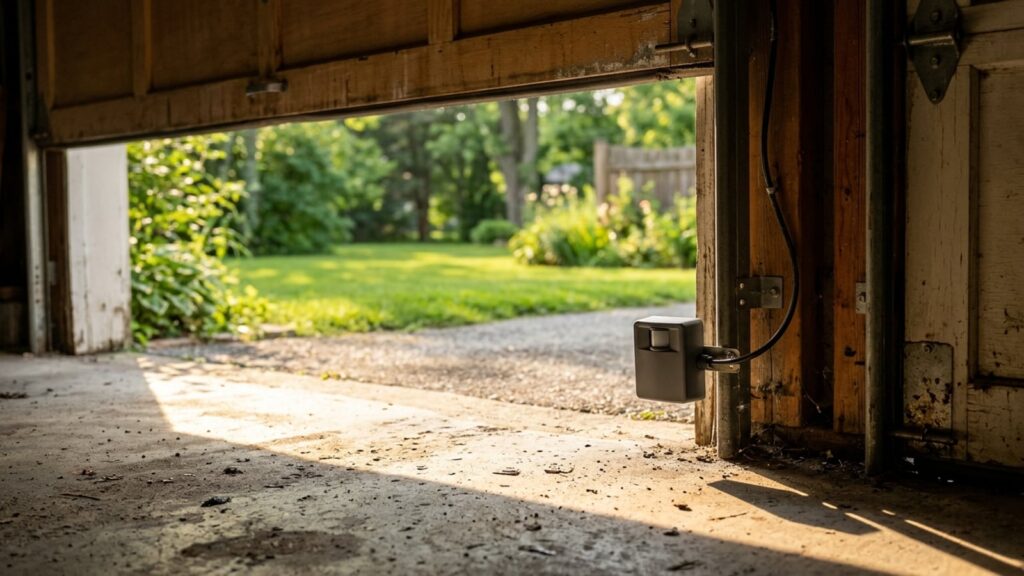
If your garage door closes fine in the morning but reverses or refuses to close on bright afternoons, the safety sensors are probably seeing the sun. Garage door sensors in sunlight can mistake the glare for a blocked beam, and the opener treats that as an obstruction. Cleaning and realigning the lenses, keeping direct sun out of them or upgrading to sensors with a lens cover usually fixes it.
July in eastern Iowa brings long, hot, bright afternoons, and a garage that faces south or west can catch the sun right across its opening. Here is how to confirm the sun is to blame, what to try first and why the same heat can make a door bind.
Why garage door sensors in sunlight cause trouble
The safety sensors, often called photo eyes, sit on each side of the opening near the floor. Genie, whose openers our technicians service, explains in its guide to its Safe-T-Beam sensors that the system sends an invisible infrared beam across the opening and reverses the door automatically if something breaks that beam while the door is closing.
Sunlight contains infrared light as well. Genie says that when the sun or another bright light shines straight into a sensor lens, it can cause a false positive and reverse the door. The opener cannot tell glare from a child in the doorway, so it does the safe thing and stays open.
How to tell the sun is to blame
Timing is the biggest clue. If the problem shows up at about the same time on sunny days, disappears when clouds roll in and never happens after dark, glare is the likely cause. Look at where the light falls when the door acts up, since a bright patch on one sensor is a strong hint.
With garage door sensors in sunlight, the sensor lights often confirm it. Genie’s troubleshooting chart for its Safe-T-Beams shows steady lights on both units in normal operation, while three blinks of the red light, a pause and a repeat mean the receiving sensor is picking up interference. Other brands use their own codes, so check the chart in your manual.
Fixes to try first
Start with a soft, clean cloth. Wipe both lenses, then make sure the two sensors face each other squarely and both lights are steady, as Genie advises. Dust, cobwebs and a sensor knocked off line by a bike or a mower can stop a door too, so rule them out first.
The lasting fix for garage door sensors in sunlight is keeping direct sun out of the lens. Genie’s own answer is an updated sensor with a lens cover that protects against outside light, which Genie says should eliminate false signals. If the sun still reaches a lens, a technician can check how the sensors are mounted and whether a shielded replacement suits your opener.
Do not tape over a lens or move the sensors higher up the wall to dodge the sun. DASMA, the association of door and opener manufacturers, sets a Six-Inch Rule in its opener safety tips: photo eyes should not be installed higher than six inches above the garage floor, because a person or pet could get under a higher beam without being detected. Genie’s instructions put its beam at least five inches, but no more than six inches, from the floor.
Summer clutter deserves a look too. Bikes, coolers, recycling bins and garden hoses parked near the opening can creep into the beam or knock a sensor bracket out of line, so keep a clear strip along both sides of the door.
How to close the door until it is fixed
You can usually still close the door by pressing and holding the wall button. DASMA’s opener maintenance guide notes that when the photo eye beam is blocked, the door should not close unless the wall-mounted button is held down for the whole trip. Stand where you can see the entire opening, keep holding until the door is down, and let go the moment anything moves into its path.
Remotes and keypads generally will not close the door while the sensors report a problem, which is the whole point of the system. Treat the wall button as a stopgap, not a fix.
When summer heat makes the door bind
Sun can cause a second summer problem that has nothing to do with the sensors. DASMA explains in its data sheet on thermal bowing that insulated doors with bonded foam cores bow when one face gets much hotter than the other, and that a south-facing door in direct sun is more likely to bow than one facing north.
The bigger the door and the bigger the temperature gap, the more it can move. DASMA notes that the bow on a 20-foot-wide door without reinforcement could exceed several inches, and an air-conditioned garage behind a sunny door widens the gap between the two faces.
The field problem DASMA describes is a top section that rubs on the header above the opening. Preventive measures typically involve reinforcing the door, for example with horizontal struts across the back, and DASMA says all repairs and adjustments must be performed by a trained door systems technician.
When to call for help
Call a technician if cleaning and shading do not help, if a sensor light stays off or keeps blinking, or if the door rubs or binds in the heat. Our team diagnoses and repairs safety sensors on all major opener brands, and sensor testing is part of every maintenance visit.
Homeowners in North Liberty, Marion and Cedar Rapids can have one of our technicians check the sensors when the afternoon sun keeps stopping the door.