
Garage Door Installation Day in Winter: What to Expect
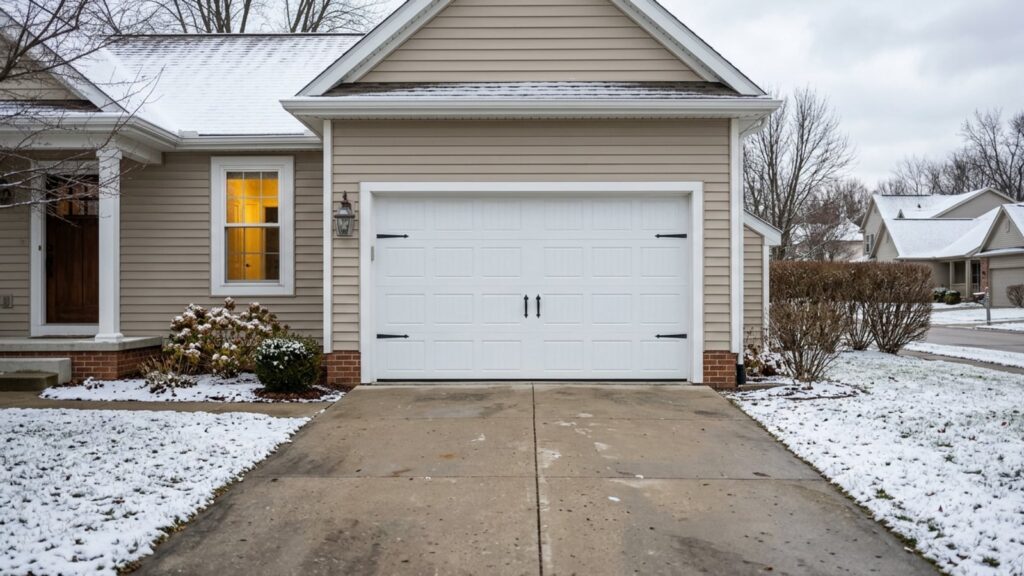
On garage door installation day, a standard residential job can usually be finished in a few hours or within a single day. The crew takes down the old door and carries it away along with its tracks and hardware, installs the new door, then checks the alignment, balance and safety sensors before leaving. Your part is to clear the space, keep children and pets away and have your questions ready.
If your new door is going in as the weather turns cold, a little extra planning keeps the day smooth and the house warm. Here is what happens, start to finish.
How long garage door installation day takes
Most standard residential installations are done within a single day, and many take just a few hours. C.H.I., a manufacturer whose doors we install, puts installation at 4 to 6 hours per door, so a garage with two single doors will take longer than one with a single double door.
Larger commercial and industrial projects vary, and we give you a clear schedule at the estimate. For standard in-stock models, lead times are minimal, while a custom-ordered door comes with a clear timeline up front, so you know when to expect our technicians.
Get the garage ready before the crew arrives
C.H.I.’s guide on how to prepare for your garage door installation starts with the cars. Move them to the street or far enough away on the driveway that the installer can back their vehicle near the garage opening. In late November, clearing any snow from the driveway the night before helps the crew get close.
Next, clear the floor. C.H.I. recommends putting away equipment, tools and trash bins or moving them to the rear of the garage, so that at a minimum the front half is empty. We ask for the same, so nothing blocks our access to the tracks and motor and your belongings stay safe while the old door comes out. Doing this the evening before garage door installation day lets the crew start as soon as they arrive.
Keep the cold out while the opening is uncovered
For part of garage door installation day, the old door will be off and the opening will be open to the weather. Keep the door between the house and the garage shut, and bring anything that should not sit in the cold indoors beforehand.
Keep children and pets well away from the garage and the driveway, too. C.H.I. points out that removing an old door and installing a new one require heavy and dangerous tools, and that the only people in your garage or driveway during the work should be the installation team.
What the crew does, step by step
DASMA, the garage door industry’s trade association, says installing a garage door can be very dangerous and is not recommended for a novice, and it recommends that trained door systems technicians do the job. Our technicians begin by taking down the old door and removing its tracks and hardware, all of which we dispose of responsibly.
The new door goes up on new track. As DASMA’s safety tips explain, an old track may not fit a new door, because the section thickness, the door’s weight, the headroom required and the opener’s location all play a part. Track and door sections function as one system. Once the door is hung, the spring tension is calibrated to balance it.
If your current opener works well and has working photo-eye sensors, we can often reconnect it to the new door. If it is outdated or underpowered for the weight of a new insulated door, we may recommend an upgrade, and we check this at the estimate rather than leaving it for the day itself.
The final safety check
Before anyone packs up, our technicians inspect the installation to make sure every rail, spring and panel is aligned. They test the balance of the door, the tension of the springs and the safety sensors, so the door operates smoothly and safely from day one. Then they clean up, and the garage is left ready to use.
What to look for before the crew leaves
DASMA publishes a checklist for home inspectors and consumers that makes a handy guide to a finished installation. Look for a spring warning label on the spring or spring bracket, a general warning label on the back of a door section and two warning labels near the bottom corner brackets, unless those brackets are tamper-resistant. The checklist notes that UL 325 requires the manual release handle to be colored red, and that the handle should sit six feet or less above the garage floor.
Wall-mounted control buttons should be in clear view of the door, safely away from all moving parts and at least five feet above any adjacent walking surface, to keep them out of children’s reach. The checklist also covers balance: with the opener disconnected, the door should stay in the fully open position and in a partially open position 3 to 4 feet above the floor. Ask the crew to show you this rather than trying it on your own.
Then use the questions you prepared. C.H.I. suggests asking your installers about maintenance, safety inspections and the warranty. DASMA also suggests keeping the owner’s manuals for the new door and opener close at hand, hung near the door where you can find them.
Planning your installation with us
To book a free estimate and choose an installation date that suits you, contact our garage door installation service. After garage door installation day, our maintenance service can keep the new door in good working order in the years ahead.