
Carriage House Garage Doors: Stamped Steel, Overlay or Wood?
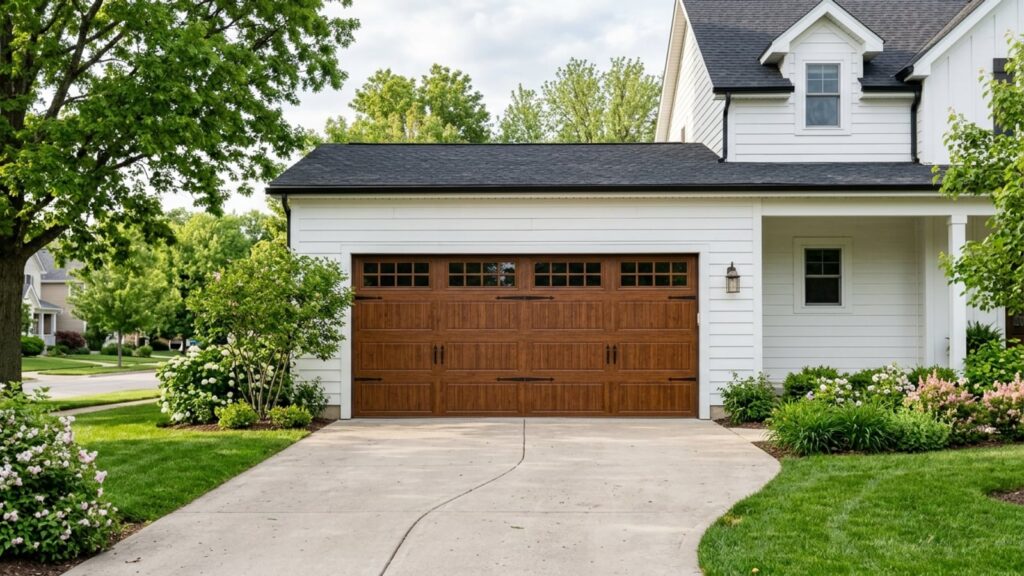
Carriage house garage doors borrow the look of the old doors from the days when garages held horses, but they open overhead like any modern sectional door. You can get that look two ways: stamped into a steel door, or built up with overlays layered on top of the base door. For an eastern Iowa home, insulated steel usually gives the look with the least upkeep, while real wood suits owners who are happy to refinish it on a schedule.
If a new door is part of your summer plans, here is how the main options compare, and what each one asks of you once it is on the house.
What makes a door a carriage house design
The look comes from square or arched panels and, on many designs, cross-shaped trim. C.H.I., a manufacturer we partner with, explains that these crossbucks are purely decorative on most modern doors, while on doors made of solid wood, similar pieces can serve a structural purpose as bracing. Amarr, another of our brands, notes that carriage house doors are built to open overhead for convenience, so you keep the old-fashioned style with the convenience of a modern door.
We install carriage house garage doors for homeowners across eastern Iowa, alongside traditional raised-panel and modern designs. One example is a custom wood overlay carriage door in North Liberty, where the natural timber finish paired well with the farmhouse exterior.
Stamped steel carriage house garage doors
On a stamped door, the carriage house design is shaped directly into the steel, with no separate overlay. C.H.I.’s stamped carriage house doors come in short and long panel designs and in 9 realistic woodtones and 9 plain colors. You can buy them with polystyrene or polyurethane insulation, or without any.
C.H.I. offers the stamped design in standard-duty and heavy-duty steel, and describes heavy-duty steel as thick for premium protection against dents, stronger impact and harsher weather. The warranty is limited lifetime, with 6 years on hardware and 3 years on springs.
Overlay carriage house doors in steel or wood
An overlay door has decorative panels layered on top of the base door. C.H.I. builds its overlay carriage house doors on two-sided steel sections 2-1/2 or 2-3/4 inches thick, in three design styles with crossbucks and square or arched panels, with polystyrene or polyurethane insulation. Steel and wood are both among its overlay materials.
The extra layer adds depth, and weight. C.H.I. notes that the extra panels make the doors heavier, with the weight depending on the material, and that its dealers inspect the doorway when taking measurements, so any strengthening work is known long before installation. Read the warranty closely too: C.H.I. covers the overlays for 1 to 3 years, and its warranty excludes extreme heat or sun exposure on black overlays.
Choosing a material for eastern Iowa weather
Steel is the low-maintenance choice. C.H.I.’s comparison of garage door materials calls steel durable and economical, but warns that rusting along the bottom section is particularly common where excess salt is used for de-icing in winter, and it recommends washing a steel door at least twice a year.
Wood looks the part but asks more of you. C.H.I. says wood garage doors best suit mild climates, because drastic changes in outside temperature and frequent contact with moisture can make wood expand and warp. Its overlay collection page also suggests talking through the materials with a professional if you live somewhere that gets extremely hot or cold.
What a real wood carriage door asks of you
If you choose wood, the finish does most of the protecting. DASMA, the industry body for garage door makers, says in its wood door finishing guidelines that all six sides of each section must be finished and that the finish coat must be applied before installation. It also warns that dark colors, especially in direct sun, may raise the surface temperature enough to shrink and crack the wood and break the finish down quickly.
After finishing, DASMA recommends inspecting, maintaining and cleaning a wood door regularly, generally every 12 to 18 months and without pressure washing. It points to the bottom section as the location of most water infiltration. How often your door needs attention depends on factors such as the type of wood, which way the door faces, the overhang above it and the original finish.
Matching carriage house garage doors to your home
C.H.I. calls overlay carriage house doors timeless, and its buyers guide says timeless classic doors are perfect for ranch, Cape Cod and craftsman homes. The look also sits well on farmhouse exteriors like the North Liberty home above. For windows, C.H.I. offers a carriage house window design, with glass choices that run from plain and tinted to frosted, obscure, seeded and rain.
Before you decide, C.H.I. suggests visualizing the door on your house with its online design tool, or requesting a free color sample to match against your home. Seeing the panels and color against your own siding makes the choice between stamped and overlay designs much easier.
Planning a carriage house door with us
Weight is worth raising early, because it affects the opener as well as the opening. When we match an opener to a door, we look at the door’s size, material and insulation thickness: a standard aluminum door may need less power, while a heavy solid wood or carriage house style door needs a strong motor. If you plan to keep your current opener, we can evaluate it during the free estimate.
When you want to see stamped steel, steel overlay and wood designs side by side, look through the manufacturers on our products page, then book a visit with our garage door installation team to measure the opening and compare carriage house garage doors for your home.