
Broken Garage Door Cable: How to Spot It and What to Do Next
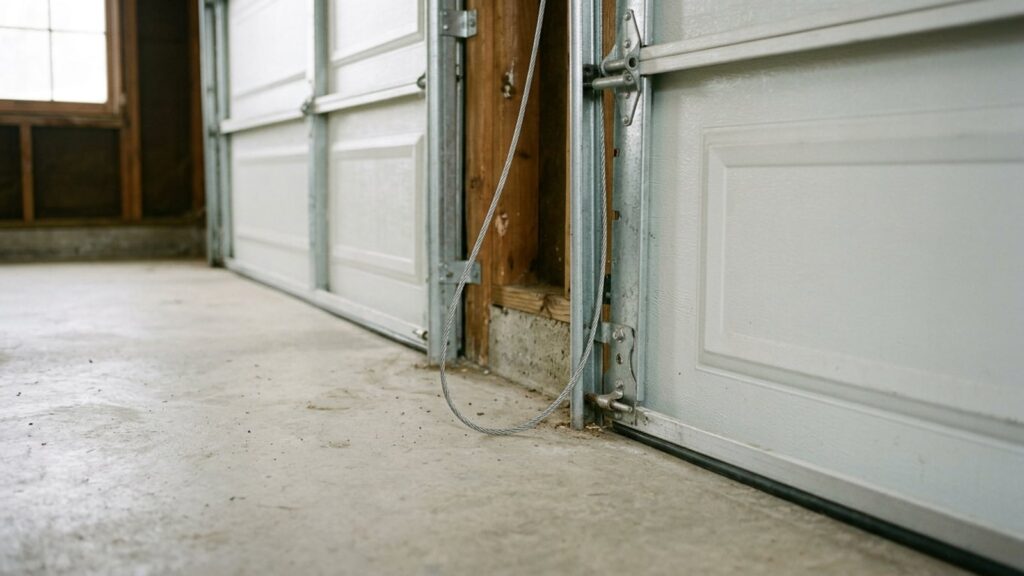
A broken garage door cable usually shows itself through a door that hangs crooked, stops partway or will not close, often with a loose cable dangling beside the track. If you see that, stop using the door, unplug the opener and keep everyone clear. The cables carry the force of the springs, and with that much spring tension involved, only a trained technician should replace them. This is not a weekend project.
The March thaw is a sensible time to look. After a winter of cold mornings and daily trips in and out, a quick check of the cables from a safe spot can catch trouble before it leaves the car stuck in the garage.
What garage door cables do
The lift cables connect the door’s spring system to the bottom brackets on each side of the door. That is how the safety tips from DASMA, the trade group for door and opener manufacturers, describe them, and DASMA warns that frayed or worn cables are in danger of breaking, which can cause injury.
On doors with torsion springs above the opening, each cable winds onto a grooved drum on the spring shaft as the door opens, according to DASMA’s terminology guide. Doors with extension springs alongside the tracks use pulleys to guide the cables instead. Either way, the cable is what turns the stored force of the springs into lift.
Signs of a broken garage door cable
A failed cable rarely stays hidden. The door may sit lower on one side, stop partway up, jam in its tracks or refuse to close. You may see a cable hanging loose, unwound from its drum or lying on the floor. Some cables snap, while others slip off the drum and leave the door hung up at an angle.
A worn cable can often be spotted before it fails. Our own checklist is short: wire strands sticking out, rust, kinks in the line and a door that looks uneven or cocked in the opening. Look from a safe distance with the door closed, and call us before a worn cable breaks.
Why a broken garage door cable is dangerous
A door with a failed cable is out of balance. The Consumer Product Safety Commission says a severely unbalanced door could unexpectedly crash to the floor, possibly striking someone under it. It can also jam at an angle in the tracks, which is no safer to work around.
Genie, an opener manufacturer, ranks broken cables as an even more dangerous situation than broken springs. Its advice is to contact a garage door service professional immediately and not to attempt to use the door. DASMA adds that the bottom brackets the cables attach to are connected to the springs and under extreme tension.
What to do about a broken garage door cable
Stop using the door. Amarr’s troubleshooting FAQ says that for safety reasons you should not try to operate a door whose cable has jumped off the drum, and should call a qualified technician instead. Unplug the opener so the motor cannot try to move a door that is out of balance.
Keep children, pets and cars away, and do not stand under a door that is stuck partway open. Leave the emergency release alone as well, since Genie’s advice is to pull it only on a closed door, which cannot move. Do not try to wind a cable back onto its drum or loosen a bottom bracket, which DASMA says only a trained door systems technician should adjust or loosen.
If the car is trapped inside, wait for the repair rather than lifting the door by hand. On the cables themselves, Amarr’s FAQ is blunt: do not attempt to remove, repair or adjust garage door springs or cable, because high spring tension can cause serious injury or death.
Safety cables on extension springs
There is a second kind of cable worth knowing about. If your door uses extension springs, the long springs that stretch alongside the horizontal tracks, DASMA says you need a safety cable that runs through each spring and is secured to the wall or ceiling at both ends. Those springs are under high tension when the door is down, and the safety cable keeps a broken spring contained.
To check, stand inside with the door fully closed and look for a cable running through the center of each extension spring, as DASMA’s inspection checklist describes. Torsion springs mounted on a shaft above the door do not need one, because the shaft already contains them. If your extension springs have no safety cables, DASMA recommends calling your local dealer for a safety inspection.
Why cables wear out, and how to keep an eye on them
Cables work hard every time the door moves. Amarr points out that the springs and lifting cables can be damaged simply by holding up the weight of the door for years, and that after extensive use the cables and springs could snap. Rust is the other enemy, and humid Iowa summers followed by snowy winters give it plenty of chances.
Amarr suggests a visual check of the springs and cables for wear and binding once a year, with a call to a professional if you suspect damage. Treat it as looking, not fixing. Stand clear of the door, keep your hands off the cables and brackets, and let a technician handle anything that looks wrong.
What a safe cable repair involves
Our technicians start by securing the door so it cannot move. They then remove the damaged lines, fit heavy-duty galvanized steel cables that resist rust and corrosion, level the bottom seal and verify the tension so the door lifts evenly on both sides.
We replace both cables even when only one has failed. Both work under the same tension and the same number of cycles, so when one wears out the other is usually close behind. Our trucks carry replacement cables, which means we can typically take care of a broken cable in a single visit.
Broken cables are one of the emergencies our technicians respond to across Cedar Rapids, Marion and North Liberty. If you have a broken garage door cable, keep the door closed and still, and schedule a cable repair with our team.