
Commercial Garage Door Maintenance: How to Build a Schedule That Works
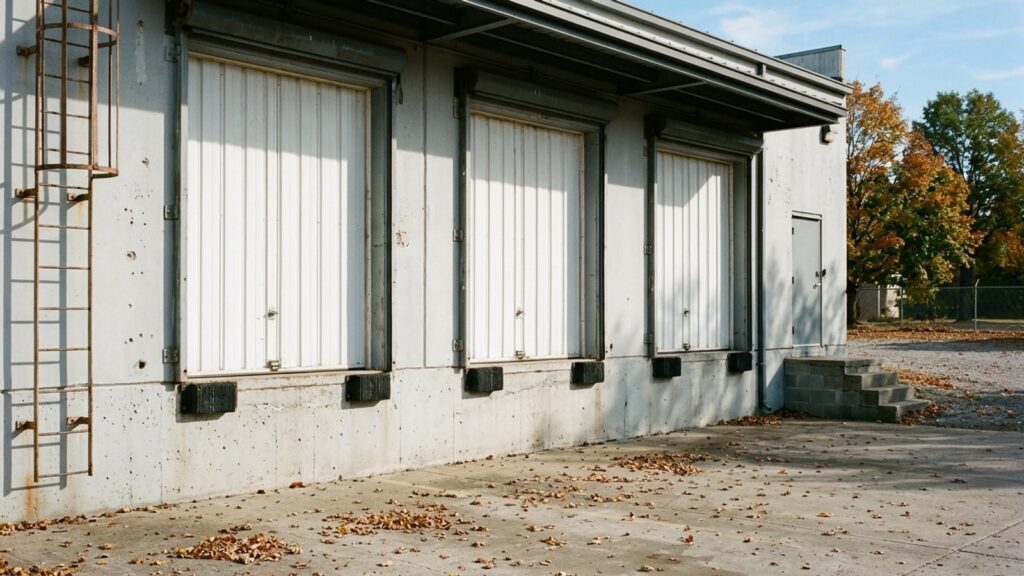
A commercial garage door maintenance plan works best in three layers: regular checks by your own staff, inspection and maintenance by a trained technician at least once a year, and an immediate evaluation after high winds or flooding. Doors that cycle all day, such as busy loading dock doors, are safer with professional maintenance twice a year. Early fall is the time to set that schedule, because inspections before winter are particularly important in eastern Iowa.
A door that fails at the wrong moment can halt deliveries or leave a building unsecured. Here is how to build a schedule for rolling, sectional and dock doors.
Why commercial garage door maintenance needs a written schedule
Busy commercial doors can work far harder than the door on a house. DASMA, which represents North American door and operator manufacturers, points out that dock doors in heavy use may open and close every hour, around the clock.
DASMA’s maintenance guidance for building maintenance supervisors says a trained door systems technician should perform periodic inspection and maintenance on rolling doors at least annually or as the door manufacturer recommends. Putting that in a written plan, with dates and every door listed, keeps the work from slipping when the building gets busy.
What your own staff can check between visits
DASMA’s rolling door evaluation for facility managers sets out simple visual and operating checks. Look at the hood for damage that could cause binding between the hood and the curtain, and check that the guides are undamaged, equally spaced from top to bottom and fastened in every slot or hole. The curtain and bottom bar should not be bent or binding in the guides, and the endlocks should not be loose or missing.
Product safety labels should be present and readable, and DASMA advises ordering any replacements from the door manufacturer. A manually operated door should rest on the floor or rise up slightly when closed, and it should close freely through the middle of the opening. On a motor-operated door, the operator should not sway, and it should stop as the bottom bar touches the floor and as it approaches the curtain stops at the top.
Keep an eye on the tension bracket while the door runs. DASMA’s maintenance practices say the tension wheel and tension shaft should remain stationary during operation, and they list loose expansion anchors in masonry walls and a bearing that looks or sounds worn among the reasons to call for service.
Quarterly checks on motor-operated doors
DASMA recommends evaluating the performance of electric doors quarterly and testing the door’s sensing devices frequently. When a door closes on an obstruction, the sensing edge should make it stop, or stop and reverse to the open position. The operation of the door should also be visible from the control switch location.
Watch for a door that is getting harder to move. DASMA says the force required to open a door should not exceed 35 pounds on a hand chain or 25 pounds on a crank, and that significant deviations from those values may indicate a counterbalance problem. An electric operator that sounds like it is laboring is another warning sign, and in both cases the next step is a call to a trained door systems technician.
What a professional service visit covers
Some parts are off-limits to staff. DASMA’s recommended maintenance practices warn that the counterbalance assembly and its related parts are under extreme spring tension at all times, so repairs and adjustments are a job for a trained door systems technician alone. Staff should never try to adjust the tension wheel.
When our technicians service a door, they inspect and tighten the hardware, including hinges and roller brackets, and lubricate the tracks and rollers. They also adjust the spring tension for proper balance, test the safety sensors and look for hidden wear on cables and panels before it leads to a breakdown.
Once or twice a year? Set the interval by use
For a lightly used rolling door, DASMA’s guidance of at least one inspection a year, or the manufacturer’s recommended interval, may be enough. For a commercial facility with high-cycle use, we consider commercial garage door maintenance twice a year the safer choice, and in eastern Iowa an inspection before winter is particularly important, ahead of the freezing temperatures and snow.
We work with property managers and business owners to create a maintenance schedule that keeps disruption to the working day low, because a malfunctioning door at a warehouse or loading dock can halt operations. Group your doors by how hard they work and give the busiest ones the shorter interval.
Add checks after storms and impacts
Some inspections cannot wait for the calendar. DASMA advises that an event such as high wind, seismic activity or flooding should require an immediate evaluation of all door systems in the facility, regardless of when the last periodic inspection was performed.
Loading docks need extra attention. DASMA’s guidance on dock doors notes that vehicles such as forklifts frequently pass through, so the clips, seals and jamb brackets there should be easy to replace or built to resist impact, and door counterbalancing should keep the door from drifting into the opening where vehicles can hit it. It also lists dock leveler gaps, keeping debris clear of the door and door maintenance among the factors in a dock door’s thermal performance.
Setting up commercial garage door maintenance with us
We maintain heavy-duty industrial doors so they meet safety regulations and keep working reliably, and emergency support is available if a door fails between scheduled visits.
If you manage a warehouse, shop or loading dock in the Cedar Rapids and Iowa City area, our commercial and residential maintenance service can set up a commercial garage door maintenance schedule around your doors and your working hours.