
Rolling Steel or Sectional? Choosing a Commercial Overhead Door
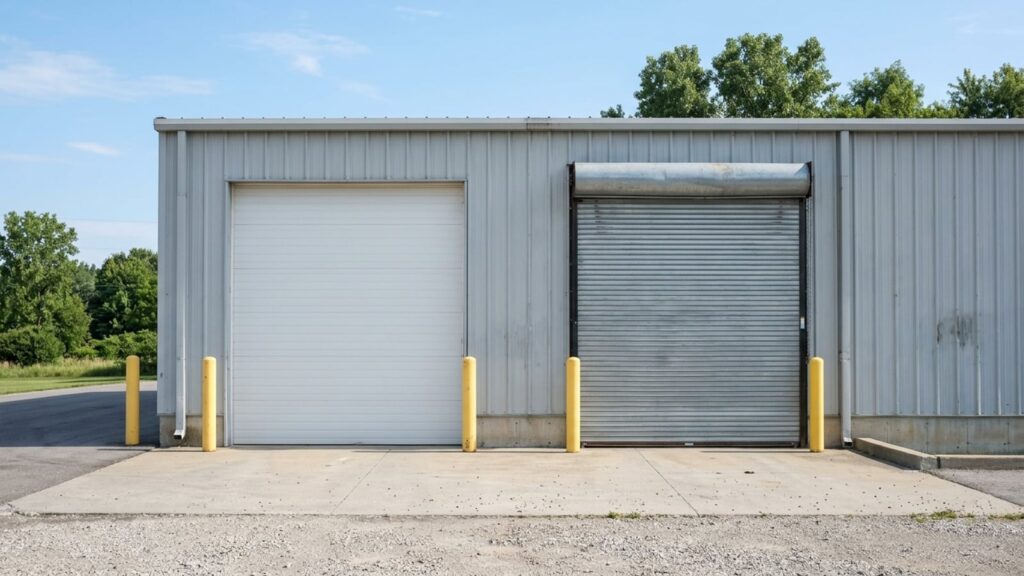
When you choose a commercial overhead door, the two designs to compare are a rolling steel door, which coils into a compact roll above the opening, and a sectional door, whose panels travel back along tracks under the ceiling. Rolling steel saves space and resists forced entry, while an insulated sectional door suits a building you heat or cool. How often the door cycles, how much room you have above and behind the opening and what passes through it decide the rest.
Summer is when the difference shows in an air-conditioned shop or warehouse, and it is a good time to plan a replacement before the weather turns. Here is how the two designs compare.
How a rolling steel door works and where it fits
A rolling door is a curtain of slats that coils onto itself as it opens. DASMA, the association for North American makers of garage doors, rolling doors and openers, explains in its guide to rolling door advantages that this keeps the room needed overhead and into the building to a minimum, so the door can go in with minimal impact on pipes, fans, ducts and conduits. Rolling doors come in widths or heights from less than 2 feet to over 60 feet.
DASMA adds that rolling doors can be mounted between the jambs, which virtually eliminates side room requirements, or under the lintel, which virtually eliminates headroom requirements. C.H.I., one of our door brands, suggests its rolling service doors for uses such as car washes, parking lots and grain elevators.
Where an insulated sectional door earns its place
DASMA defines a sectional door as two or more horizontal sections hinged together, running on tracks and track rollers, so the door travels up and back under the ceiling as it opens. Those sections can be insulated, which is why we install sectional models for their insulation and rolling steel doors where security and saving space come first.
C.H.I. lists fire and ambulance stations, climate-controlled factories, climate-controlled agricultural buildings, warehouses, manufacturing facilities and truck terminals as uses for its insulated sandwich sectional doors. If your building keeps a controlled temperature inside, that list is a good guide to where this design fits.
Check headroom, depth and obstructions first
Space often makes the decision for you. A sectional door needs headroom above the opening for its track and hardware, plus backroom, the clear depth into the building, for the panels to travel into. DASMA’s guidance on dock doors recommends maximizing adjoining warehouse space with vertical lift or high lift track, depending on the building and door geometry, and says a rolling door may also be used where overhead space or depth into the room is limited.
DASMA also recommends keeping electricity, HVAC, water lines and fire suppression systems outside the door operating zone, which can save unnecessary construction time and expense. Our team knows the building codes and safety regulations in Cedar Rapids and the surrounding area, and we make sure every overhead door we install meets its structural and safety requirements.
Insulation, air leaks and the building’s climate
If the space inside is heated or cooled, the door is part of the building envelope. DASMA says the choice of dock door depends partly on building thermal performance, including U-factor and air infiltration, and that sectional or rolling doors can be specified as insulated if separation of environments is a concern. For the door itself, it lists panel material and thickness, the door-to-jamb seal and the section interface among the factors.
When you compare doors on thermal performance, ask for the tested U-factor of the whole assembly. DASMA’s technical considerations for dock doors say it should be determined using either ANSI/DASMA 105 or NFRC 100/NFRC 102. DASMA’s Thermal Performance Verification Program, which standardizes U-factor reporting for thermally efficient sectional garage doors, does not include rolling steel doors.
Security and wind
Rolling steel doors earn their place where security comes first. DASMA notes that rolling doors offer high levels of security against forced entry, and that rolling doors of any size can be designed to withstand the stiffest wind loads required by building codes for hurricane or tornado conditions.
Wind matters at the dock too. DASMA says that where a local code has been adopted and is being enforced, the local authority having jurisdiction determines the door performance requirements, and that wind load performance should be determined in accordance with ANSI/DASMA 108. Ask what wind load any commercial overhead door you are quoted is designed for.
Match the commercial overhead door to how hard it works
A storefront door that opens a few times a day and a dock door that cycles constantly need different treatment. DASMA notes that a heavy use dock door can have an hourly, round-the-clock open and close duty cycle, and that mounting clips, weather seals and jamb brackets should be designed for easy replacement or impact resistance, because forklifts and other vehicles frequently pass through.
Rolling doors can be operated by manual lift-up, chain hoist, crank or electric motor operator, DASMA adds, and an operator can be mounted above, to the side of or in front of the door, or even on the other side of the wall. That flexibility helps when the wall around the opening is already crowded.
Planning a commercial overhead door with us
DASMA treats a dock door as an integral part of the loading dock system, alongside levelers, seals, shelters, lights and communication systems that must work together. That is why it helps to plan the door and the dock together, and we supply loading dock equipment as well as doors, including dock levelers, vehicle restraints, dock seals and shelters.
To weigh rolling steel against a sectional commercial overhead door for your building, talk to our commercial and residential installation team, and see the dock equipment we supply on our products page.