
Repair or Replace a Garage Door Opener? How to Decide
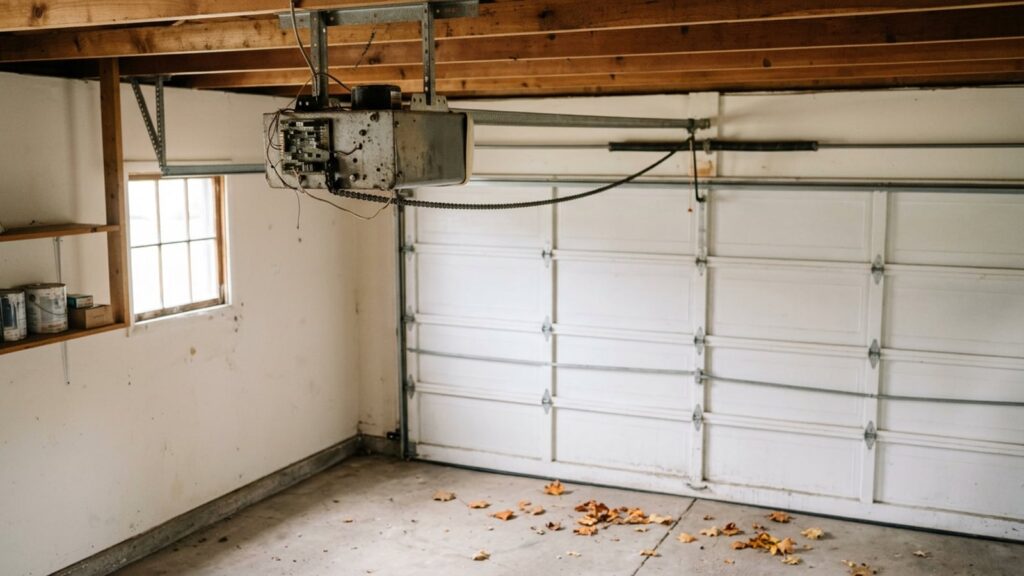
Whether to repair or replace a garage door opener starts with one question: does it stop and reverse when it should? If the opener has no photo eyes, or fails the reversal test and cannot be put right, replace it. If it passes, many faults, from sensors and remotes to a logic board, can be repaired, and the opener’s age and the size of the repair decide the rest.
Mid-October is a good time to settle it. An opener that has been slow, noisy or unreliable all summer is better sorted out before winter, when a door that will not open is more than an inconvenience.
Start with the safety test
Federal rules have required openers to reverse for more than three decades. The CPSC’s safety sheet on non-reversing openers says openers made or imported for sale in the U.S. after January 1, 1991 must have reversing systems, and that a requirement for an external entrapment protection system, such as an electric eye near the floor, was added in 1993.
If your opener lacks that second safety reversing feature, DASMA says in its opener safety tips that it is time for a new opener, and the CPSC urges homeowners with openers that do not reverse to repair or replace them. To check yours, look for photo eyes on both sides of the opening no higher than six inches above the floor, then run the reversal test in your owner’s manual.
Age alone can be a safety issue. Amarr, a door manufacturer, warns that an old opener can bring several safety hazards, since its automatic reversal may not work correctly, and that a faulty opener can also leave the garage open to thieves.
Faults that are usually worth repairing
Amarr also notes that many garage door openers can be repaired and that repair may be the less expensive option. Genie, an opener maker, says a defective safety sensor can be swapped in a few minutes and a surge-damaged circuit board can be replaced, though an older opener may be due for replacement instead. Genie also lists a motor that hums but does not move the door as a possible sign of stripped internal gears.
Some problems are not really opener failures at all. Genie lists a dead remote battery, a remote used out of range and one that simply needs reprogramming among the reasons a door may not respond, and none of those is a reason to buy a new opener.
Motors, logic boards, safety sensors and remotes are all opener parts we diagnose and repair, and our trucks are stocked with components for the major brands. On an opener that is otherwise sound and passes its safety tests, replacing one failed part is often the sensible choice.
Check the door before you blame the opener
Before you repair or replace a garage door opener, make sure the door itself is healthy. DASMA’s opener tips say a door that feels heavy or needs two hands to lift is probably out of balance, and that the answer is not a more powerful opener, because openers are designed to move doors that are properly balanced.
Amarr adds that worn or broken springs make the door heavy and put an extra load on the opener, which can be dangerous for the reversing system and lead to early opener failure. A new opener on an unbalanced door inherits the same problem. DASMA warns that you could get hurt trying to fix the balance yourself and says to call a trained door systems technician, so have the door checked as part of any opener decision.
Signs an opener is near the end
Age is part of the picture. Genie puts the average life of a garage door opener at 10 to 15 years in its guide to signs it is time to replace, and its warning signs include an opener that works only some of the time and a door that opens or closes on its own, gets stuck or stalls, or reverses when opening or closing.
Genie adds two signs that are easy to dismiss. A door that opens slowly may be held back by old springs or other worn parts, and screeching or scraping from the opener can mean it needs repair or replacement, because an aging motor has more and more trouble pulling the door open. Have the springs and door checked first, since a slow or noisy door is not always the opener’s fault.
Security is another reason to upgrade. Genie notes that older openers used small dip switches to set a code that never changed and could be guessed, while rolling code systems change the code every time the remote is used. Genie counts that old technology among its reasons to replace an opener.
How to decide whether to repair or replace a garage door opener
Put the pieces together. A sound opener with one failed part, working safety features and a balanced door is usually worth repairing. An opener that lacks photo eyes, keeps needing repairs, is past the average life Genie gives or still uses fixed codes is usually the better one to replace.
Ask for the facts before you decide. Our technicians begin with a diagnostic inspection and give you a clear price for parts and labor up front, before any work starts and whoever installed the opener. If an older opener may not meet current safety standards, we will say so, because we put honest recommendations ahead of sales pressure.
One practical point if you do replace: DASMA’s inspection checklist calls for a grounded or GFCI outlet within reach of the opener’s cord and says extension cords are not permitted. If your current opener runs on an extension cord, plan for an electrician to add an outlet.
Still deciding whether to repair or replace a garage door opener? Start with a diagnostic repair visit anywhere in Cedar Rapids, Marion or Tiffin, and we will tell you plainly whether yours is worth fixing.